

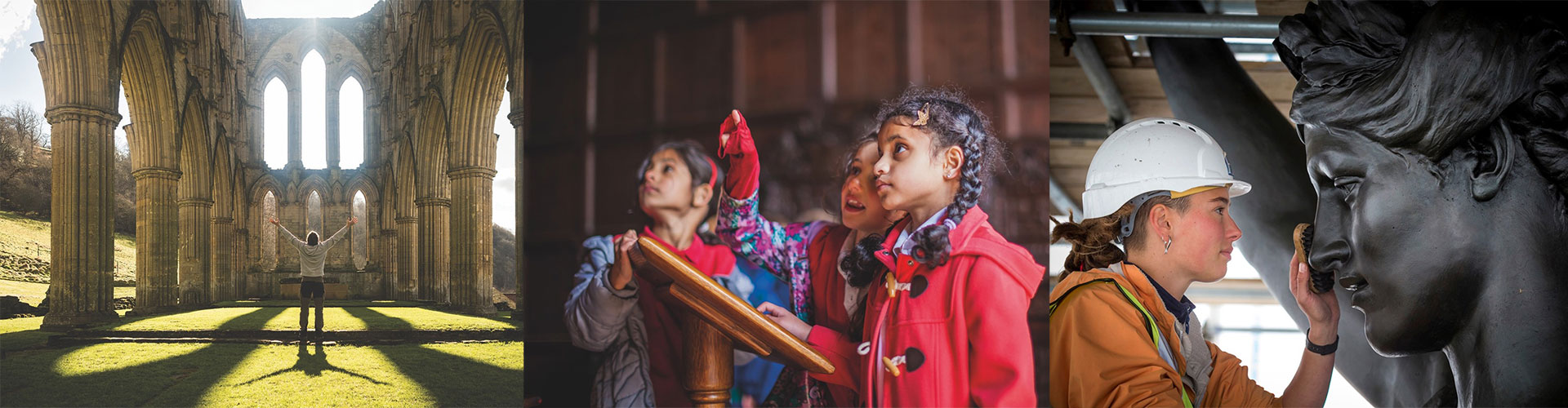
English Heritage manages the National Heritage Collection of over 400 historic sites and one million artefacts on behalf of the Government under licence from Historic England. Our charitable objectives include ensuring the conservation and enhancement of the Collection, promoting the public knowledge and enjoyment of it, and advancing the appreciation of history through the Blue Plaques Scheme.
The stories attached to the historic places in our care span six millennia and include palaces, houses, hill figures, castles, abbeys, industrial sites, Roman forts and even deserted medieval villages. We are unique in having responsibility for such a large collection of sites where key events of national significance have unfolded. In addition, we play an important role in many of the most deprived parts of England where our work drives growth in the local economies, supporting local employment and supply chains.
Creating inspirational visitor experiences that bring the stories of England to life and caring for our sites and collections for the benefit of this and future generations is a cornerstone of everything we do. The generosity of our Members, donors and other supporters enables us to do this.
Our strategic plan focuses on four key areas, outlined below. The transformational changes we are delivering are enormous and exciting, covering not only financial and operational matters but also for example our new approach to sustainable conservation.
Inspiration
We aim to create inspiring and enjoyable experiences for everyone at our sites, online and in print, enabling people of all ages and backgrounds to share in and pass on the stories of England. We have made enormous strides in uncovering and inspiring people with diverse stories in innovative and artistic ways.
We are constantly striving to improve the experience of visitors to our sites, of which diverse storytelling is just one element. Recent major projects include the spectacular new footbridge at Tintagel Castle, which allows visitors to experience this dramatic site in a completely new and more accessible way, and award-winning interventions at Whitby Abbey which provide a much-improved experience for visitors of all ages. We have also re-opened Cliffords Tower in York and Marble Hill in Greater London after significant investment.
In addition to developing inspirational and innovative experiences at our sites, our experts continue to produce varied and distinctive digital content, including a wealth of free materials such as award-winning podcasts, high-quality resources for teachers and information about the 900+ individuals who have been recognised through the London blue plaques scheme, famous names ranging from Sir Isaac Newton to Virginia Woolf, Agatha Christie, and Bob Marley.
We also produce a range of well-regarded and authoritative guidebooks, along with other publications such as These Our Monsters – a book of eight short stories written by different authors including Booker Prize nominees.
Conservation, Stewardship and Sustainability
Conserving and maintaining our sites is one of our biggest responsibilities and an on-going challenge, both financially and strategically. A one-off government grant in 2015 has helped us make significant progress in bringing our sites into good repair and we have developed a new sustainable conservation strategy to make sure this money is spent as efficiently and effectively as possible. We always maintain the very highest standards and, wherever possible we use local craftsmen and traditional techniques, and we engage members of the public with this vital work through our Conservation in Action programme.
We are also addressing the challenges of climate change and the impact it is already having on our sites, including Hurst Castle, which has undergone major repairs after being badly damaged by extreme weather and high tides. We have recently launched our Climate Action and Sustainability Plan to help us mitigate our impact and prepare for the future.
In addition to conserving and maintaining the estate, our experts care for more than 700,000 objects in our collections, many of which are on display at our sites. England’s largest and most significant collection of historic wall paintings is also in our care, and can be seen at a range of sites, including St. Mary’s Church Kempley, Bolsover Castle and Lullingstone Roman Villa.
Involvement and Inclusion
England’s stories belongs to everyone, and we provide an extensive range of rewarding opportunities for people of all ages and backgrounds to experience, explore and become involved in caring for the country’s heritage. We are passionate about improving equality, diversity and inclusion for our visitors, Members, employees, volunteers and in how we tell the story of England. We will drive all of this work through our Equality, Diversity, and Inclusion Strategy. From remote rural sites to urban monuments and offices, the diversity of our teams is critical in making sure our shared heritage is inclusive, exciting, and accessible.
We currently have about 4,700 volunteers who support us by working directly with the public, for example in welcoming or story-telling roles, or by working behind the scenes in a variety of areas such as gardening, administration, and conservation work. A recent highlight was the recreation of a Bronze Age roundhouse at Beeston Castle by a team of over 60 volunteers. This has strengthened ties between the site and the local community and many of those involved in the construction now talk to visitors about what they have achieved.
Financial Sustainability
Before Covid-19 struck we were on target to achieve financial sustainability by 2022/23. Whilst the pandemic, cost of living crisis and lower levels of international tourism have affected visitor numbers, we are on track to deliver a balanced budget for 2025/26. This will be the first time this has been achieved without government support.