

Our Purpose
At the Duke of Edinburgh’s Award (DofE), we help young people build lifelong belief in themselves, supporting them to take on their own challenges, follow their passions, and discover talents they never knew they had.
Because when you prove to yourself that you’re ready for anything, nothing can hold you back.
Our Values
Underpinning every aspect of our work are our shared values. They define our culture, show what we stand for and describe how we get things done.
I am empowering
I trust my colleagues, I create opportunities for others to learn and develop, I am positive and solutions focused, I learn from my experience and that of others, and I celebrate achievement in all its forms.
I am inclusive
I am a team-player and collaborate with others to find the best solutions,I am friendly and approachable, I value diverse perspectives and actively seek to understand and act on the insights and lived experiences of others.
I have integrity
I do what I say I will, I am tenacious about maintaining high standards and am always looking for ways to make things better, I willingly take on responsibility and I stand up for what I believe to be right.
I am dynamic
The needs of young people are central to my decision making, I am optimistic, enthusiastic and open to new ideas, I’m agile in my approach and I make working and volunteering with DofE a fun experience.
Our Strategic Ambitions
We want to make DofE more accessible and relevant, giving more than one million young people over the next five years the chance to participate in a life-changing DofE programme.
Our Story
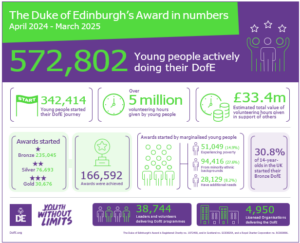
Since our inception DofE has helped millions of young people navigate the, often bumpy, path to adulthood. Now under the patronage of the current Duke of Edinburgh, HRH Prince Edward, the Award now reaches over half a million young people across the UK each year and is growing year on year.
The flexibility and adaptability of DofE has allowed the Award to spread around the world. We operate through a social franchise model in the UK, licensing and supporting a diverse range of organisations to deliver DofE programmes to hundreds of thousands of young people every year.
This model allows our charity to reach far more young people than our staff of c380 might suggest.
We now manage a network of over 4,700 Licensed Organisations delivering the DofE, including schools, colleges, community organisations, young offenders’ institutions, businesses and uniformed youth groups, with the support of over 40,000 incredible adult volunteers.
Our ambition to grow the number of young people who can access a DofE programme and extend our reach to the most marginalised young people, is being enabled by innovative new partnerships, effective advocacy and developments to the Award programme. We continue to develop creative ways of working with businesses, voluntary sector and policy makers across the UK to ensure that any young person who wants to do their DofE can do so.
Our Impact
DofE’s latest Impact research measures the difference participating in DofE makes to young people across a range of key outcomes. We have used a groundbreaking open data methodology to enable us to examine the impact of participation on young people’s social and emotional development, wellbeing and sense of belonging, and to compare this against data for the UK youth population as a whole.
Analysing responses from 40,880 DofE participants, our findings show a statistically significant positive impact on wellbeing, skills development, community ties and physical activity for young people doing their DofE.
Our methodology means we can also measure the social value of these improvements in wellbeing in monetary terms. Using the best practice methodology set out in the 2021 HM Treasury Green Book, our results show that wellbeing improvements experienced by DofE participants have an estimated average social value of £4,400 per person.
Crucially, DofE participation also appears to act as a protective factor, helping to counteract some of the negative trends seen in young people’s wellbeing during adolescence. In three out of four wellbeing measures, young people report statistically significant improvements from the start to the end of a DofE programme, with improvements in life satisfaction higher for girls and young women and participants from minority ethnic backgrounds.
Today’s young people are growing up in an uncertain and uniquely challenging world. More than ever, we need to find ways to support their development, safeguard their wellbeing and build their independence and essential skills. Our 2024 impact data presents an encouraging picture of the impact of DofE participation on young people.
Dan’s Story
Making a difference with young people in custody
Take a look at our secure estate work in action
One of our priorities is to make DofE accessible to young people who are at risk or marginalised. We are very proud that DofE has a growing presence in the secure estate and we currently partner with 41 prisons and young offenders’ institutions. A study into the impact of the DofE in the secure estate, carried out by a team of researchers from Glyndwr and Cardiff Universities, showed that after engaging in DofE activities young people demonstrated a more positive attitude in relation to:
- offending in general
- higher levels of victim empathy
- less perceived reward for crime
- reduced anticipation of re-offending
- perceived fewer life problems in
The CRIME-PICS ll research, supported by Dr Chai Patel’s Bright Future Trust, proved that a greater sense of self-belief and self-esteem helped to improve young offenders’ chances for a brighter future and increase their resilience and resistance towards re-offending.
Case Studies
Further examples of the impact the DofE’s vital work is having on young people can be seen in the video case studies linked below:
Young at Heart: Restricted Space Expedition
Aspire 2 Inspire: DofE Journey
About DofE’s Governance
The Duke of Edinburgh’s Award is a charity and Royal Charter corporation. The DofE also operates a subsidiary trading company, Award Scheme Ltd (ASL).
DofE UK is licensed by the International Award Foundation, a separate charitable entity, to operate DofE across the whole of the UK. We licence and support a very wide range of organisations that work with young people to run DofE programmes in every community in the UK. The DofE has a close working relationship with the International Award Foundation and other Award Operators in 130 countries across the world.
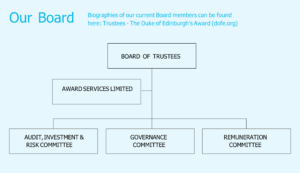
The Board of Trustees is responsible for setting the Duke of Edinburgh Award’s strategic direction, monitoring the delivery of the charity’s objectives and upholding its values. All Trustees are equal in their duties and responsibilities.
The Board of Trustees is supported by the following subcommittees:
- Audit, Investment and Risk Committee
- Governance Committee
- Remuneration Committee
This Trustee appointment will bring essential financial expertise to the Board and as such the successful candidate will be expected to Chair sub-committee on Audit, Investment and Risk and act as our Lead Trustee for financial sustainability.
New Trustees are appointed by the existing members of the Board. When filling Trustee vacancies, the Board takes into account the skills, expertise and lived experience needed to maintain the Board’s ability to direct effectively the full range of the charity’s activities.
All Trustees receive an induction to help them understand the role and responsibilities of being a new Trustee and to learn more about the Duke of Edinburgh’s Award. Further training and development is offered to Trustees during their term of office as required.
In accordance with recommendations set out in the Charity Governance Code, the charity formally reviews its full governance framework every three years. The next review is due to take place later this year.